The strip still read as a warning after twelve months and it no longer read the same. The domes lost height at the walk line and kept it at the edges, which is exactly the pattern the standard's spacing assumes and no specification measures.
A year of traffic on one tactile strip
written 2026-08-12kept by The Nosing Line (a named line, not a person)
What was measured
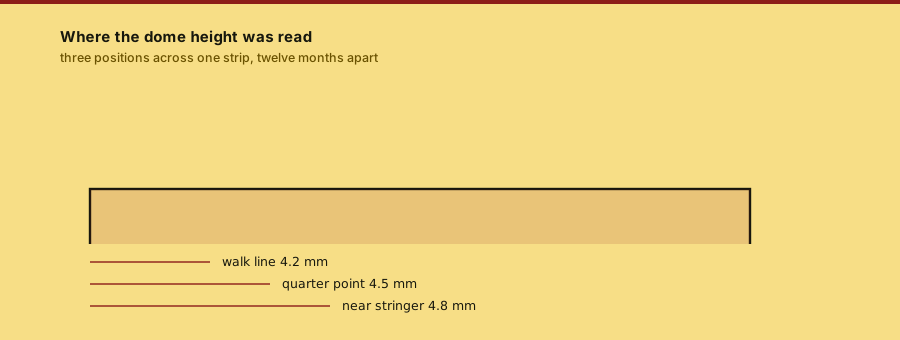
A cast tactile strip on the top landing of an internal stair in a building with steady weekday traffic. Dome height was measured with a depth gauge at three positions across the strip before installation and again after twelve months: at the walk line, at the quarter point, and 150 mm in from the stringer.
| Position | At installation | After 12 months | Loss |
|---|---|---|---|
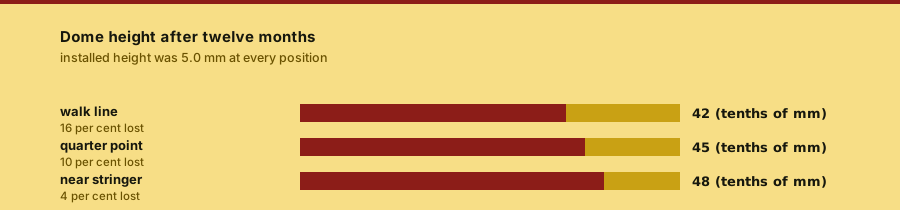
| walk line | 5.0 mm | 4.2 mm | 16 % |
| quarter point | 5.0 mm | 4.5 mm | 10 % |
| 150 mm from stringer | 5.0 mm | 4.8 mm | 4 % |
Why the pattern matters
The loss is not uniform and it is not random. It concentrates where the traffic concentrates, which is the walk line, and it is smallest where almost nobody steps. A strip that is checked at the stringer will look almost new a year in. A strip that is checked at the walk line will show the real number.
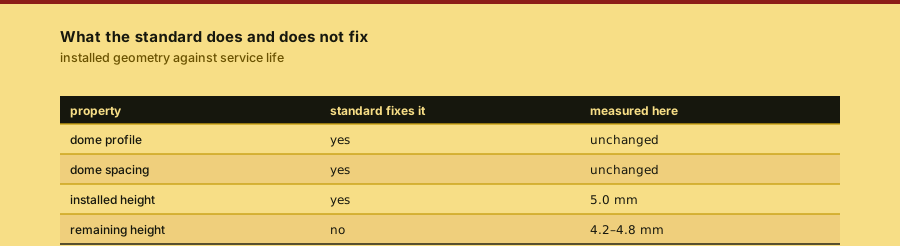
That is a maintenance question rather than a specification question, because the standard fixes the installed geometry and the spacing of the domes. Nothing in it sets a service life or a minimum remaining height, so the decision about when to replace a strip is a decision the building makes, and it needs a reading to make it with.
The strip was still detectable underfoot after twelve months at every position measured. That is a useful negative result. A loss of 16 per cent at the walk line did not take the strip below the point where it reads, which suggests the replacement interval for this product in this building is longer than a year.
The sentence a practitioner may dispute
A tactile strip that has lost 16 per cent of its height at the walk line should not be replaced on that number alone. The number to act on is the point at which the strip stops reading underfoot, and this strip had not reached it. Arguing for replacement on a percentage rather than on a detection threshold is how maintenance budgets get spent on the wrong strip, and that argument is contestable.
What this note does not cover
It does not cover the slip performance of the worn strip, which is a separate measurement on a separate instrument and would need its own record. It does not cover a strip in a wet or external location, where the loss pattern is different. Both are open questions on this line.
Documents checked
- 1ISO 23599:2019 Tactile walking surface indicators (Swedish Institute for Standards catalogue)supports the installed geometry and dome spacing that the strip was specified to
- 2Resources -- IDEA Center, Center for Inclusive Design and Environmental Accesssupports the accessible-design resource base a tactile specification is drawn from
- 3Center for Inclusive Design and Environmental Access (IDEA Center) -- University at Buffalosupports the inclusive-design centre whose guidance covers detectable warnings
Each line points at one specific document, with its own title as the link text. No line is a home page and no line is a search result.
File this and go Close this note once you have the two readings and the position they were taken at. A wear number without its position is not a wear number.