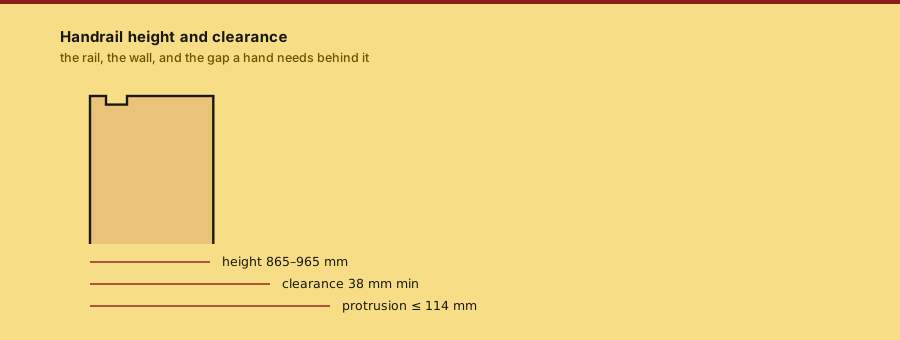
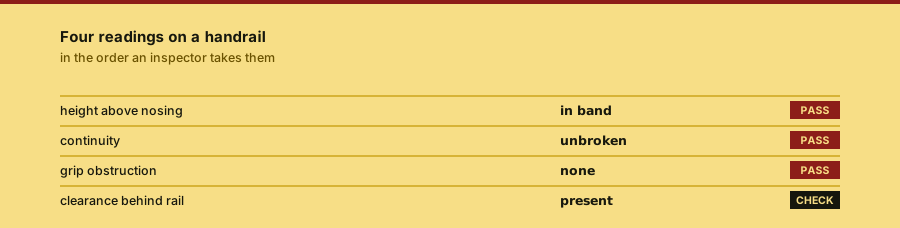
A handrail is judged on three things and only the first is a height. The band is wide because it has to serve a standing adult, a child, and someone pulling themselves up; the clearance and the cross-section are what make the band usable.
Handrail: the height, the clearance, the grasp
checked 2026-09-16rots yes — the figures above move with the editionkept by The Nosing Line (a named line, not a person)
What is actually required
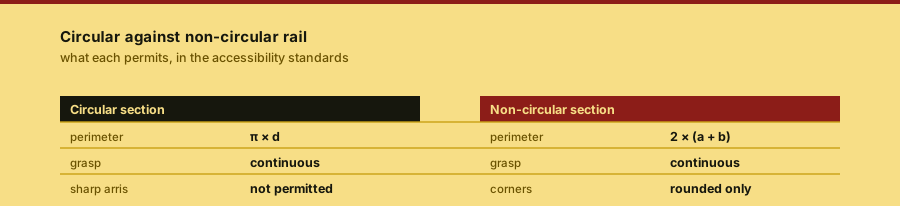
The American accessibility standards require handrails on both sides of a stair that forms part of a required means of egress, continuous within the full length of each flight, and continuous around the inside of a switchback. The gripping surface must be unobstructed on the top and the sides, free of sharp or abrasive elements, and free of anything that interrupts a continuous grip.
The same standards put a hard number on one case that catches people out. A wall-mounted handrail whose leading edge sits higher than 27 inches cannot protrude more than 4½ inches into a circulation path. That is the rule that fails a corridor handrail, not a stair handrail, and it is why the rail on a stair landing is often the one that gets cited.
| Requirement | Figure | Source |
|---|---|---|
| Both sides, full length of each flight | required | ADA §504.6 |
| Protrusion into a circulation path | ≤ 4½ in above 27 in | ADA §505.5 / §307.2 |
| Grip surface | unobstructed top and sides | ADA §505.6 |
| Handrail shape | rounded, no sharp arris | ADA §505.5 |
| Stair rail system | per fall-protection rule | 29 CFR 1910.28 |
Why the height band is not a number
A rail set for a standing adult is too high for a child to reach and too high to be useful on the way down a short flight. The accessibility standards resolve this with a recommendation rather than a requirement: in facilities that primarily serve children, a second set of stairway handrails 28 inches high maximum above the stair nosings is advisable, with a vertical clearance of at least 9 inches between the upper and lower rails so that nobody is caught between them.
A handrail is not the same as a guard. A guard stops a fall over an edge; a handrail is something to hold. A single element can do both, but only if it satisfies both sets of clauses, and the height bands they demand are not identical.
What is owned elsewhere
The guard that keeps people off the edge is owned by the guard page. The width a handrail is allowed to eat out of a stair is owned by the egress width page. This page owns the rail itself.
Documents checked
- 1eCFR :: 29 CFR 1910.28 -- Duty to have fall protection and falling object protectionsupports the fall-protection duty that a stair rail system sits inside
- 2Access to and use of buildings: Approved Document M (GOV.UK)supports the UK position on handrails where a stair forms part of an accessible route
- 3Chapter 3: Protruding objects -- Guide to the ADA Standardssupports the protruding-object rule that caps how far a wall-mounted rail may project
Each line points at one specific document, with its own title as the link text. No line is a home page and no line is a search result.
File this and go Close this page when you know which of the two jobs your rail is doing. The clauses follow the job, not the rail.