There are at least three published slip-resistance scales in common use and they do not convert into one another. A product can carry a good number on one scale and an unusable one on another, because each scale was built on a different contaminant.
Slip resistance: the number, the rig and the band
checked 2026-09-16rots yes — the figures above move with the editionkept by The Nosing Line (a named line, not a person)
The bands, as published
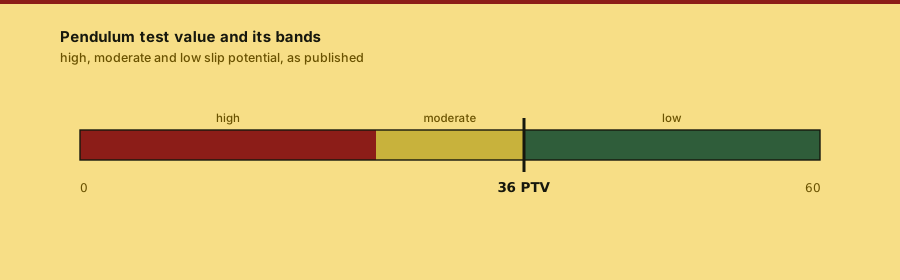
The British safety executive publishes the pendulum bands directly, taken from the UK Slip Resistance Group guidance. A pendulum test value from 0 to 24 is high slip potential. From 25 to 35 it is moderate. From 36 upwards it is low. The same document publishes a microroughness band for water-wet pedestrian areas: below 10 micrometres of Rz is high slip potential, 10 to 20 is moderate, and 20 and above is low.
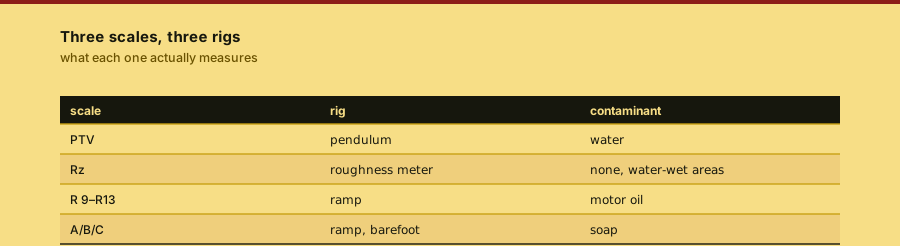
The R scale comes from a German ramp test with motor oil as the contaminant and heavily cleated safety boots on the operator. R9 covers slip angles of 6 to 10 degrees, R10 covers 10 to 19, R11 covers 19 to 27, R12 covers 27 to 35, and R13 is above 35. The companion barefoot test uses a soap solution and grades A from 12 to 17 degrees, B from 18 to 23, and C above 24.
| Scale | Bands | Contaminant and operator |
|---|---|---|
| Pendulum PTV | 0–24 high, 25–35 moderate, 36+ low | water, slider 96 rubber |
| Rz microroughness | <10 high, 10–20 moderate, 20+ low | water-wet areas only |
| DIN 51130 R | R9 6–10° to R13 >35° | motor oil, cleated boots |
| DIN 51097 A/B/C | A 12–17°, B 18–23°, C >24° | soap, barefoot |
Why the scales do not convert
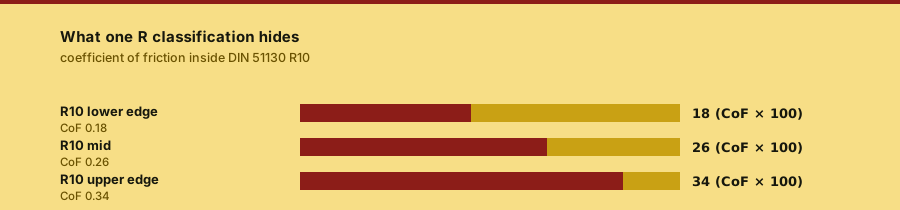
The published guidance makes the point with a worked comparison. R10 covers a coefficient of friction from 0.18 to 0.34, which is a very wide range of slip potential compressed into one classification. Two floors with the same R10 label can be nearly twice as different from each other as either is from the band boundary. A specification that names R10 and nothing else has specified almost nothing.
The British executive is also explicit about the ramp methods themselves: it has reservations about them, because neither uses contaminants representative of those commonly found in workplaces. Motor oil and soap are not what a stair in a hospital or a food factory actually sees.
Manufacturer data is usually produced on as-supplied product. The guidance says plainly that the slipperiness of flooring changes after installation, so a factory number is a starting point and not a condition report. A factory reading is not the same as a site reading, and neither is the same as the condition the floor is in today.
Owned elsewhere
The nosing the surface is wrapped around is owned by the nosing page. The measurement procedure is owned by the pendulum check. This page owns the scales and their bands.
Documents checked
- 1Assessing the slip resistance of flooring: A technical information sheet (HSE)supports the pendulum PTV bands, the Rz bands and both DIN angle classifications
- 2Preventing slips and trips at work: A brief guide (HSE INDG225)supports the employer's duty that makes a slip assessment necessary in the first place
- 3F1637 Standard Practice for Safe Walking Surfaces (ASTM F1637-21)supports the practice standard that governs safe walking surfaces and their maintenance criteria
Each line points at one specific document, with its own title as the link text. No line is a home page and no line is a search result.
File this and go Close this page once you know which scale your specification named. Two of the three cannot be converted into the third.